14/08/2026
Associate Prof. Dr. Kamer Kaya, a faculty member at Sabancı University's Faculty of Engineering and Natural Sciences, has been awarded funding for the international project titled "FEniCS Lighthouse: Automating Multiphysics Finite Element Methods for Exascale," in which he will lead performance optimization processes, under the HORIZON-JU-EUROHPC-2026-COE-LH-01-03 call for proposals. Sabancı University, in its capacity as a research university, is participating in the project, which will conduct studies aimed at performing massive-scale scientific simulations on Europe's next-generation supercomputers.

The FEniCS Lighthouse (Project No: 101319095), coordinated by Simula Research Laboratory, will be implemented under the Research and Innovation Actions (HORIZON-JU-RIA) program. The consortium, which brings together universities and research centers from Norway, Türkiye, the United Kingdom, Luxembourg, and France, includes Sabancı University, as well as Koç University, University of Cambridge, University College London (UCL), Université du Luxembourg, INRIA, and CNRS.
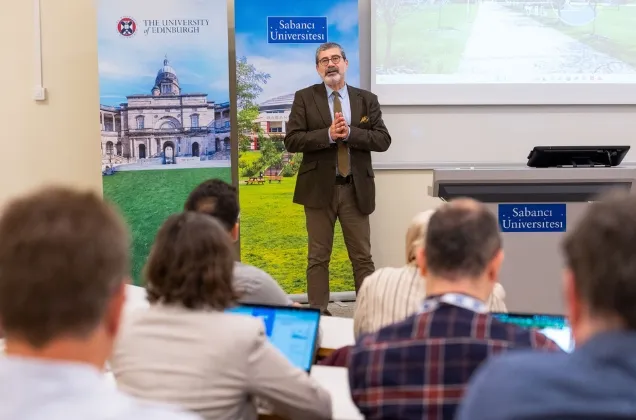
Assoc. Prof. Dr. Kamer Kaya will contribute to performance optimization processes.
Assoc. Prof. Dr. Kamer Kaya, who conducts research on sparsity-aware code generation and optimization with parallel sparse matrix, graph, and tensor calculations on modern hardware, will contribute to the performance optimization processes of the FEniCS Lighthouse project.
Previously working on high-performance algorithms for sparse data in the EuroHPC-supported SparCity project, Assoc. Prof. Dr. Kamer Kaya will transfer the experience he gained there to the FEniCS Lighthouse project. Within the scope of the project, Kaya will also play an active role in strengthening the parallel computing infrastructure of FEniCSx for distributed systems.
FEniCSx to be Ready for Next-Generation Supercomputers
The FEniCS Lighthouse project aims to bring the open-source FEniCSx software framework, which has a large global user base in finite element computing, to next-generation supercomputers. As part of the project, FEniCSx's automated code generation infrastructure will be extended to include GPUs; new hardware-oriented optimizations will be added to the code generator and core function library.
The project, which focuses on running massive-scale simulations on NVIDIA and AMD GPU-based supercomputers in Europe, will also develop new partitioning methods and software tools for distributed computing by leveraging inter-GPU communication libraries. The developed capabilities will be validated with large-scale computation examples such as cardiovascular system simulation and molecular-level simulation to be run on European supercomputers.
The project also aims to grow the FEniCSx user community by organizing open workshops and training activities. It is also planned that the software management processes will continue uninterrupted after the completion of the project.
The project will enable Sabancı University to transfer its expertise in sparse computations, parallel algorithms, and performance engineering to Europe's next-generation computing ecosystem. The methods to be developed within the scope of the project are expected to contribute not only to FEniCSx but also to various other scientific computing applications.